Walking along a woodland path, the adjacent foliage was heavily overgrown. But something still caught the corner of my eye at the base of a large oak tree. At first, I thought people had left some rubbish, considering the size, but as I removed the overgrowth (receiving many lovely nettle stings!) the picture became clearer.
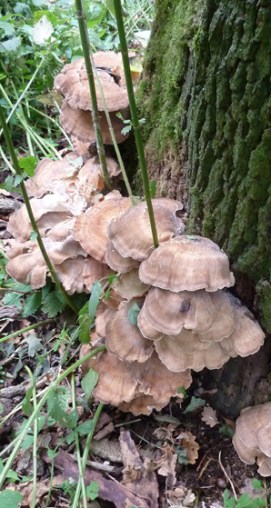 This was indeed a Giant Polypore (Meripilus giganteus or Polyporus giganteus) occupying a good half of the tree’s circumference. Older parts on one side and younger ‘new’ born’ specimens emerging on the other.
A common mistake would be to confuse this bracket fungus with Hen of the Woods (Grifola frondosa) but on comparing notes, you’ll realise that these things are just too damn big! And the ones featured here will grow bigger still.
The fruiting bodies of this Polypore branch out in clumps. Each clump shares the same short and chunky stem, at the end of which are numerous fan-shaped caps ranging in size from 40 – 90cm in diametre, but are relatively thin compared to this width. They’re quite tough (but flexible) to prize away from the central stem, so a good sharp knife is in order!
Apart from their large size, the caps have reliable and distinctive markings. Their light brown ‘overall’ colour (which darkens with age) display several concentric, light/dark zones. On closer inspection you’ll see a layer of very fine brown scales. The edges are fanned or rosette-like and slightly grooved.
The Giant Polypore might not be as tasty as Chicken of the Woods but it is edible. It does smell quite nice but can taste quite bitter. But just like the Beefsteak Fungus, there maybe be a cooking preparation method to make this taste alot better. I haven’t tried myself, but it’s worth a go I think.
Keep a look out for these beauties this autumn. They can be found at the base of (mainly) beech or oak trees (or nearby, emerging from the underground roots) and sometimes on stumps. If you do take some samples you’ll notice after time the pores on the underside turn blackish where touched or bruised. Although unsightly, I don’t believe this affects the final taste, if prepared like the Fistulina hepatica for example.

The Giant Polypore – Older specimens appear darker brown (top) while younger ones are a lighter shade (bottom). Note the pure white pores underneath (middle) showing a much younger specimen on the right.
QUICK ID TABLE: GIANT POLYPORE Meripilus giganteus / Polyporus giganteus |
FRUITING BODY 50-80cm across. Made up of rosette formations with short stems fusing at a common base. Each of the fan shaped caps range from 10-30cm across / 1-2cm thick. Upper surface concentrically zoned light and darker brown. Covered in fine brown scales; radially grooved. Flesh is white, soft and fibrous. STEM See above. PORES / SPORE PRINT Late in forming; 3-4mm, sub circular shape. White(ish) bruising blackish.
Spore Print: White (see how to take a spore print here). HABITAT / SEASON At the base of deciduous trees or stumps; mainly beech or oak. Can grow from roots of tree away from trunk appearing indepent of tree. EDIBILITY Edible. Can be bitter. |
The Genus POLYPORUS & Related (Polypores etc): Characteristics to look out for: • Nearly all are bracket fungi, but a few are with typical cap and stem but with pores instead of gills underside.
• Usually tough or hard and woody. Some are softer and edible.
• Many are perennial or annual. |

 The commonly named Yellow Stagshorn (Calocera viscosa) can be found always growing on dead and rotting coniferous stumps and logs, or appearing to grow from the soil, but this is due to underground rotting wood.
 The Brown Roll-Rim (Paxillus involutus) is a very common toadstool found throughout the UK and Europe. I have come across it many times in mixed woodland. If picked for eating it can lose it’s toxicity once thoroughly cooked, but over time and if eaten on a regular basis, it’s toxin will enter the bloodstream and systematically cause the destruction of the red blood cells. Not very pleasant and definitely not worth the risk. There’s no real timescale for when and if this will happen, but I think it’s best described as a ticking time-bomb!