I can’t believe it’s not Butter! The Butter Cap

Sorry for the awful title, but it had to be done! I can’t believe I haven’t made a post on this mushroom before either. Next to the Brown Roll Rim, this has had to have been the most common mushroom I’ve found in great number during autumn/early winter last year (2011).

Collybia butyraceaOften found in woodland in large scattered groups or even as solitary souls, the Butter Cap (Collybia butyracea / Rhodocollybia butyracea*) is a very common edible mushroom (hence being categorised in my ‘Woodland Treats’ blog category) but does not have a particularly pleasurable texture or amazing taste (so I’ve put it in ‘Tales of Toadstools / The Inedibles’ category too).

The texture of the cap, as the common English name suggests, is very smooth, slippery and greasy – not unlike the sensation when you run your finger on some butter… As you do!

To my now ‘trained eye’ they are instantly recognisable. But as you’ll find with experience, the appearance, specifically the cap, can be a very unreliable visual marker for identification due to colour variations. These variations can also be exaggerated due to moisture level and age etc…

The unreliable cap colour can range from dark red/brown, ocherous/buff brown to pale bone-white or ivory (usually with a much darker centre) when older and dryer. Also adding to the confusion is that this species has a common ‘lighter’ variation (Collybia butyracea var. asema) which (I think) is currently under debate. It is generally lighter all round in colour, and I’m making an educated guess that the centre picture below is a good example of this variant.

The shape of the cap and the gills are fortunately more reliable, usually with a shallow dome shape and distinctive raised bump at the centre (or umbo). Sizes in width can differ from small to medium-large (3 – 8cm) and the margin (edge) is lighter than the rest of the cap, sometimes becoming irregular and even ‘wavy’, often showing a faint striated edge (see Mushroom Identifaction Page for more info on Margin/Edge ID features). The gills are crowded, free from the stem and remain white(ish).

But for best identification I always examine the stem. It shares the same brown shade shown on the cap and typically has a slightly thicker base compared to the thin tapering at the apex where it joins the cap. It becomes hollow towards the base which is darker, often covered in fine white down. A little test to confirm identification is to break apart the stem. It is very tough and stringy and you will see also where it is hollow at the base.

You can take a quick ‘smell’ test, but again, I wouldn’t fully rely on this for a good ID tip. It can be very mildly mushroomy or even slighty rancid. So there you go!

Note: As I mentioned earlier, this species is abundant in mixed Woodland throughout autumn to early winter, but while out on a recent foray that they can appear in grassland near woodland, but it doesn’t happen often. The small group I found in November 2011 were of the lighter variety, large and creakily shaped. Obviously they were going mad trying to get themselves back to the woods. Maybe!

*Note: To date, some members of the Collybia family have been moved to new genera due to DNA research and some may have different names. ‘Collybia butyracea’ still seems to be currently used here and there, but technically speaking it is ‘Rhodocollybia butyracea’.

Collybia butyracea - var.asema

Butter Caps (Collybia butyracea var.asema) abundant in leaf litter in autumn through to early winter. Note the ‘broken apart’ stem base which is covered in fine white down (bottom-left). It is stringy, tough and hollow.

QUICK ID TABLE: BUTTER CAP Collybia butyracea / Rhodocollybia butyracea

CAP / FLESH

3-7cm accross. Initially convex; flattening out, developing distinctive central bump (umbo). pale ochre – reddish brown (dependent on what variety). Drying to reveal patches of ivory white. White flesh with mushroom smell. Greasy (buttery) to touch.

STEM

2.5-5cm x 0.5-1cm. Tough. Slightly bulbous at base. Similar colouring to cap. Becoming hollow. Base when broken is stringy and fibrous.

GILLS / SPORE PRINT

Free, crowded and whitish.
Spore Print: White or very pale pink (see how to take a spore print here).

HABITAT / SEASON

Leaf litter in deciduous or coniferous woods. Autumn – early winter.

EDIBILITY

Edible but not great.

The Genus COLLYBIA (Toughshanks); RHODOCOLLYBIA taxonomy for this species: Characteristics to look out for:

• Tough, fibrous/flexible stems.
• No ring or volva present.
• Gills often crowded / never decurrent.

ExCEPtional! – The Penny Bun, Cep or Porcini mushroom

The Bolete genus (and those closely related) are some of the largest and most exciting mushrooms to be found out there. From a culinary point of view there are several that are more than worth the their place in the kitchen, but there is one in particular that stands out as ‘best of the rest’.

Boletus edulisSo let’s get it’s name sorted out. Most people will definitely recognise common/local names, a couple of which are not English in origin. Our common tongue has described this as the ‘Penny Bun’ for obvious reasons (although probably not to todays generation), many also know it as the Cep (French) but then most cooks and chefs will often know it from it’s Italian translation as the ‘Porcini mushroom’. But at the end of the day, science has kept things in order, strictly labeling it as Boletus edulis – the latin name ‘edulis’ simply meaning ‘edible’. Very apt, as usual.

Excluding Truffles, the Cep (as I’ll call it from now on) is one of the most highly prized edible finds, especially in mainland Europe. Some foragers only have this one mushroom on their list, such is their passion for it.

It is a very distinctive looking mushroom with it’s stout, chunky stem and small ‘out of proportion’ cap (common to younger examples – shown opposite). They can sometimes pop up in abundance or smaller groups, but are often solitary near/under broad-leaved and coniferous trees.

The picking season can be as early as June or July, but often show up from August to September. With this year’s season being mostly dry, only November has been reliable in dishing out the goods – for me this year anyway!

Young specimens are usually favoured over older specimens (often maggot-ridden) and will be cooked or pickled whole, or even dried for later consumption. They freeze extremely well too.

The pores in older ‘middle-aged’ specimens change from white to a dull yellow-green colour (as the spores are olive green/brown). The tubes are usually removed and the cap is thinly sliced along with the stem (peeled first) to add to the pan. Overall, it’s good to know there are many ways to store, cook and eat this mushroom. I’m no top chef , but there’s lots of ideas out there. A great selection of recipes with the cep mushroom can be found on the BBC website here.

There are a couple of edible ‘look-a-likes’ often confused with the Cep, such as the The Dark Cep (Boletus aereus) and maybe the Bay Bolete (Boletus badius). But beware the Bitter Bolete (Tylopilus felleus) with a dark network on its stem. Although not posionous, it’s a recipe for disaster when served up at dinner time. As the name suggests it has a very bitter, unpleasant taste.

So a useful feature to note in identifying the Cep is looking for the raised ‘white’ network/pattern on the stem (reticulation) as shown in the picture below. None of those mentioned above share this feature.

Good hunting…

The Cep

What a difference! A large middle aged/mature specimen next to a younger example. Notice the ‘white’ raised network on the stem and how the pores age ‘yellow/green’ compared to the paler white colour of younger ones.

Boletus edulis Mushroom UK

A young, perfectly from Cep mushroom discovered in Leicestershire UK – open grassland near woodland.

QUICK ID TABLE: CEP Boletus edulis

CAP / FLESH

8-25cm across. Brown. White line at margin of cap. Smooth and dry becoming greasy. Viscid in wet weather. Flesh is white (flushed dingy yellow or vinaceous in the cap).

STEM

3-23cm x 3-8cm. Often swollen at base. Pale with white network covering the stem.

PORES / TUBES / SPORE PRINT

Pores are small and round, initially white; ageing yellow, then greenish-yellow. Tubes are white, becoming grey-yellow.
Spore Print: Olivaceous walnut-brown (see how to take a spore print here).

HABITAT / SEASON

In coniferous, broadleaved or mixed woods. Summer – late autumn.

EDIBILITY

Edible. Excellent.

The Genus BOLETUS (the Boletes): Characteristics to look out for:

• Have pores (open ends of tubes) on the underside instead of gills. Easily separated from the cap.
• Most have dry caps (viscid when wet – but not glutinous like Suillus genus).
• Most have reticulation on the stem; a fine network covering parts or all of the stem. Make note of the colour.
• When cut or bruised take note of any changes in colour to the flesh or pores.

Halloween Special – The Witch’s Hat

This mushroom is one of, if not ‘the‘ most common of all the Waxcaps (known as the Hygrocybes) which I recently discovered on the 30th October. By posting on the first day of November I realise I’ve missed the Halloween deadline (excuse the pun) and I’m sorry. But Halloween ‘is’ the eve of ‘All Saints Day’ – making my error simply forgiven! Or something like that…

Hygrocybe conicaAlthough it has been a relatively bad season for mushrooms and fungi alike due to the dry weather, this last week has proved fruitful, especially in relation to Waxcaps.

Because of the excellent timing, I had to feature the ‘Witch’s Hat’ or ‘Blackening Waxcap’ (Hygrocybe conica) to be my latest post.

As the common and scientific name suggests, the cap of this very common grassland mushroom is ‘conical’ in shape, usually broadly conical or bell-shaped (often irregularly lobed). The texture, common with all Waxcaps, is slimy and waxy and although quite small, is very noticeable in the grass due to it’s bright and striking colours. In this case, the colour can vary somewhat, but mainly you can see yellow/orange (sometimes with scarlet shades) – even hints of green can be present.

But the main feature you will recognise (again, shared with some other Waxcaps), is the ‘blackening’ effect (sounds very seasonal and horrific!). The older the mushroom is – the blacker it will get – although it does not auto-digest and turn to ink like the gills of the Inkcap genus.

Very old specimens turn completely black and appear to be decayed or burnt out. If picked, you will also notice it will bruise black upon handling. But if left alone, the blackening process will slowly take effect, starting mainly from the cap edge (see image above).

Keep a look out this (late) autumn and you may find some along with it’s more colourful friends. It can be found mainly in grassland in fields and woods, but is also common in ornamental lawns, waysides and even plant pots (as my mother discovered!) due to it being less sensitive to nitrogen enriched soil.

It is classed as edible and sometimes as inedible or poisonous from different references. But it is not deadly, and I’m guessing – not very palatable. It’s just best for looking at, which is good because it’s so good looking…

Witches hat

Very common Waxcap, found in field or woodland grass. Bright orange/yellow (sometimes with red or green hues) that blackens with age (see far left).

QUICK ID TABLE: BLACKENING WAXCAP / WITCH’S HAT Hygrocybe conica

CAP / FLESH

3-5.5cm accross. Conical or bell-shaped. Often irregularly lobed. Waxy. Yellow/ Orange colours. Blackens with age.

STEM

3-7 x 0.6-1 cm. Yellow, scarlet flush. Blackening streaks with age.

GILLS / SPORE PRINT

Adnexed or free. Pale yellow. Waxy.
Spore Print: White (see how to take a spore print here).

HABITAT / SEASON

Grass in fields or woods. Ornate gardens and plant pots too. Autumn.

EDIBILITY

Edible,but best avoided.

The Genus HYGROCYBE (Waxcaps): Characteristics to look out for:

• Small sized caps brightly coloured in reds, yellows, oranges, greens and whites.
• Caps are often conical or domed and normally greasy or slimy.
• Gills are waxy. Some bruise blackish when damaged.

See Kew gardens conservation news on the British Waxcap family here.

Timebomb Toadstool – The Brown Roll-Rim

The words ‘Mushroom’ and ‘Toadstool’ are not truly scientific names, but general common usage describes these as edible or inedible (and poisonous) fungi respectively. But there is a grey area, (internationally speaking) regarding this mushroom or should I say toadstool?. It is still sold in eastern Europe markets, where-as here at home in the UK, it is strongly advised to be avoided. Over time, this fiendish toadstool can release it’s toxins and seriously poison you…

Brown roll-rimThe Brown Roll-Rim (Paxillus involutus) is a very common toadstool found throughout the UK and Europe. I have come across it many times in mixed woodland. If picked for eating it can lose it’s toxicity once thoroughly cooked, but over time and if eaten on a regular basis, it’s toxin will enter the bloodstream and systematically cause the destruction of the red blood cells. Not very pleasant and definitely not worth the risk. There’s no real timescale for when and if this will happen, but I think it’s best described as a ticking time-bomb!
The common name helps describe this naughty toadstool quite well. Naturally a brown toadstool, it’s rim remains ‘inrolled’ although less so when expanded as it grows – see picture on the left – excuse long fingernails!). The texture when younger is finely felted and later becomes smooth (slimy when wet).

Size-wise, it can grow from 5 – 15cm in diametre when fully mature and has a distinct hazel brown colour (tawny brown / olive when younger), often dotted with darker orange/brown blotches and the margin may become very wavy.

The crowded, decurrent gills are a reliable feature for identification also. They ‘bruise’ dark brown on handling are easily separated from the cap flesh.

Being very common in broad leaved and sometimes coniferous woodland (even parks and gardens), you will most likely stumble across these toadstools during late summer to late autumn. They have been classed as deadly poisonous and therefore, to repeat myself again, just avoid them. Several deaths have been reported from Europe. Better the devil you know – to coin a phrase!

Note: See comments boxes below. To eat or not to eat! I know I won’t be eating them!

Paxillus involutus

The Brown Roll-Rim Toadstool – Viscid when wet and brusing dark brown on the gills (top). Younger examples are more finely felted when young before becoming smoother.

PS. If you want to get scientific – check out this eco-news on the study of this very mushroom (and related species): http://www.jgi.doe.gov/sequencing/why/99182.html

QUICK ID TABLE: BROWN ROLL-RIM Paxillus involutus

CAP / FLESH

5-15cm across. Inrolled margin. Ochre – hazel-brown colour (often with darker rain post marks). Downy texture when younger, becoming smoother. Slimy when wet.

STEM

8cm x 0.8-1.2cm. Similar but lighter colour as cap. Stains darker with age.

GILLS / SPORE PRINT

Crowded and decurrent. Light ochre to sienna. Bruises darker.
Spore Print: Sienna brown (see how to take a spore print here).

HABITAT / SEASON

In broadleaved woodland and on heaths. Late summer – late autumn.

EDIBILITY

Poisonous. Can be deadly. Regular consumption build up toxins within the body. Avoid.

Tree slippers – The Giant Polypore

Walking along a woodland path, the adjacent foliage was heavily overgrown. But something still caught the corner of my eye at the base of a large oak tree. At first, I thought people had left some rubbish, considering the size, but as I removed the overgrowth (receiving many lovely nettle stings!) the picture became clearer.

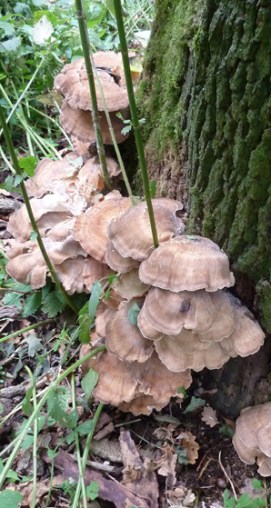
Meripilus giganteusThis was indeed a Giant Polypore (Meripilus giganteus or Polyporus giganteus) occupying a good half of the tree’s circumference. Older parts on one side and younger ‘new’ born’ specimens emerging on the other.

A common mistake would be to confuse this bracket fungus with Hen of the Woods (Grifola frondosa) but on comparing notes, you’ll realise that these things are just too damn big! And the ones featured here will grow bigger still.

The fruiting bodies of this Polypore branch out in clumps. Each clump shares the same short and chunky stem, at the end of which are numerous fan-shaped caps ranging in size from 40 – 90cm in diametre, but are relatively thin compared to this width. They’re quite tough (but flexible) to prize away from the central stem, so a good sharp knife is in order!

Apart from their large size, the caps have reliable and distinctive markings. Their light brown ‘overall’ colour (which darkens with age) display several concentric, light/dark zones. On closer inspection you’ll see a layer of very fine brown scales. The edges are fanned or rosette-like and slightly grooved.

The Giant Polypore might not be as tasty as Chicken of the Woods but it is edible. It does smell quite nice but can taste quite bitter. But just like the Beefsteak Fungus, there maybe be a cooking preparation method to make this taste alot better. I haven’t tried myself, but it’s worth a go I think.

Keep a look out for these beauties this autumn. They can be found at the base of (mainly) beech or oak trees (or nearby, emerging from the underground roots) and sometimes on stumps. If you do take some samples you’ll notice after time the pores on the underside turn blackish where touched or bruised. Although unsightly, I don’t believe this affects the final taste, if prepared like the Fistulina hepatica for example.

Polyporus giganteus. Giant Polypore

The Giant Polypore – Older specimens appear darker brown (top) while younger ones are a lighter shade (bottom). Note the pure white pores underneath (middle) showing a much younger specimen on the right.

QUICK ID TABLE: GIANT POLYPORE Meripilus giganteus / Polyporus giganteus

FRUITING BODY

50-80cm across. Made up of rosette formations with short stems fusing at a common base. Each of the fan shaped caps range from 10-30cm across / 1-2cm thick. Upper surface concentrically zoned light and darker brown. Covered in fine brown scales; radially grooved. Flesh is white, soft and fibrous.

STEM

See above.

PORES / SPORE PRINT

Late in forming; 3-4mm, sub circular shape. White(ish) bruising blackish.
Spore Print: White (see how to take a spore print here).

HABITAT / SEASON

At the base of deciduous trees or stumps; mainly beech or oak. Can grow from roots of tree away from trunk appearing indepent of tree.

EDIBILITY

Edible. Can be bitter.

The Genus POLYPORUS & Related (Polypores etc): Characteristics to look out for:

• Nearly all are bracket fungi, but a few are with typical cap and stem but with pores instead of gills underside.
• Usually tough or hard and woody. Some are softer and edible.
• Many are perennial or annual
.

Two Toned Treat – The Sheathed Woodtuft

Here we have a fairly common and sought after tasty mushroom for this time of the year. It likes to grow in dense clusters on stray stumps and logs of broad-leaved trees – Just like many other brown toadstools too! Hmm!?

Velvet ToughshankThe Sheathed Woodtuft (Kuehneromyces mutabilis) has also adopted other common names, such as Velvet Toughshank, Brown Stew Fungus and Two-toned Pholiota, even though it is not strictly a Pholiota species. But I have seen it named as ‘Pholiota mutabilis’ somewhere else. It just goes to show that scientific names change from time to time as the scientific knowledge of fungi continually advances.

And talking of scientific names ‘mutabilis’ literally means ‘changeable’ in latin. A good choice of name I think, because the caps of this mushroom which are ‘shiny and brown’ (even orange-brown – see last pictures below) when moist can change to paler ochre from the centre outwards as it dries. This gives them the characteristic two-toned appearance.

On discovering any type of brown mushrooms on dead wood, most people become instantly suspicious. I don’t blame them at all. Unless you are familiar with other brown woodland species, identification can be a challenge. It has been known to be confused with Honey Fungus, Velvet Shank and Sulphur Tuft all of which grow in similar numbers on dead wood and share certain visual characteristics.

The main identification concern here though is the deadly Funeral Bell (Galerina marginata). Nature has thrown this one into the mix just to annoy and terrify the average mushroom hunter. I don’t currently have any images to show, but if you look elsewhere you’ll see what I mean. The cap can look frighteningly similar in size and shape and also dries lighter brown at the centre (again, depending on moisture level). Fortunately, one reliable comparison is that it has a ‘smooth and silvery’ stem, whereas the Sheathed Woodtuft’s brown scales (beneath the ring) are unmistakable.

Other features such as location, time of year, gills and spore print are not effectively reliable for comparison. So it goes without saying that if you intend to eat them, take extra care in the identification process. If you’re 100% happy just try a small portion first, leave it 24 hours to see how you go, just like you should with all mushrooms you eat for the first time. There’s always a small possibility of an allergic reaction, but fear not, for if it is the Sheathed Woodtuft, it won’t kill you!

I have to admit, the general appearance of this mushroom hasn’t inspired me to eat it, but apparently it is known to be very good with a pleasant nutty taste. But I’m willing to give it a go soon. I think!

Keuehneromyces mutabilis

In groups on logs and stumps in woodland the Sheathed Woodtuft (Keuehneromyces mutabilis). Notice the scales beneath the ring on the stem. This feature is NOT on the similar and deadly Funeral Bell (Galerina marginata)

A slightly younger and fresher group of Sheathed Woodtufts, much more Orange/Ochre in colour.

QUICK ID TABLE: SHEATHED WOODTUFT / BROWN STEW FUNGUS Kuehneromyces mutabilis

CAP / FLESH

3-7cm across. Initially convex shape then flattenned out; often umbonate (with a small bump). Orange-brown to brown. Becomes lighter in the centre as it dries, giving a two-toned colour effect.

STEM

3-8cm x 0.5-1cm. Whitish at the apex, darker towards the base. Smooth above the ring, finely scaly below.

GILLS / SPORE PRINT

Adnexed. initially pale then later cinnamon-brown.
Spore Print: Deep yellow-brown (see how to take a spore print here).

HABITAT / SEASON

In dense clusters on stumps and standing/fallen trunks of deciduous trees. In many numbers. Spring to early winter

EDIBILITY

Edible and good. Take care not to confuse with Galerina marginata (The Funeral Bell) a deadly lookalike; focus on the stem differences.

Flaky Pholiota – The Shaggy Scalycap

It’s always a joy to find great big clumps of mushrooms while out foraging, especially when you’re not having much luck elsewhere. When you can’t find one mushroom – a bunch of them come along at the same time. Typical!

Pholiota squarossaAlways found at the base of living trees, the Shaggy Scalycap (Pholiota squarossa) is usually found in large, visually striking groups. The first time I found a particularly large gathering of 20 or so together, I was hoping they were edible. In fact I was ‘wishing’ that they were! But in fact they’re just too bitter to be enjoyed which is a great shame considering their size and abundance in which they grow.

The name Pholiota means ‘scaly’ in greek which is a very apt name for this particular genus, all of whom share the common trait of bearing scales on their cap and/or stem. But our common Shaggy Scalycap is one of the best examples at showing this feature off.

The cap, which ranges in size from 3 to 12cm, is a particularly dull or straw-like yellow covered in thick brown ‘upturned’ scales, and it doesn’t stop there! The long stem is just the same, with the scales becoming finer and smaller towards the darkening base. Apart from the crowded cinnamon brown gills (pale yellow when young) the only smooth area to be found is just above the torn ring zone – very close to where it meets the cap.

Although fairly common in the UK mainly with deciduous trees, the Shaggy Scalycap is particularly common in the Rocky Mountains with aspen and spruce trees. So that adds up to great scenery with the bonus of impressive mushrooms. It’s all good.

Other identification tips are in the ID chart below, but before you look there I thought I’d make a note about the poisonous Inocybe terrigena which can sometimes look familiar if you’re not used to the Shaggy Scalycap. But fortunately this not-so-common toadstool (one the ‘Fibrecaps’) grows on it’s own in chalky soils and not in dense clusters at the base of trees.

Pholiota squarossa

The Shaggy Scalycap grows at the base of living trees, often in large and dense clusters

Pholiota squarossa

Close up of the scaly cap and stem. Note the smooth area on the stem above the torn ring.

QUICK ID TABLE: SHAGGY SCALYCAP Pholiota squarossa

CAP / FLESH

4-12cm across. Convex; sometimes bell-shaped. Inrolled margin. Pale yellow with coarse brown scales.

STEM

5-12cm x 1-1.5cm. Like cap in colour; darker brown at the base. Smooth texture above the ring.

GILLS / SPORE PRINT

Subdecurrent and crowded. Initially yellow, maturing to cinammon.
Spore Print: Rusty brown (see how to take a spore print here).

HABITAT / SEASON

At the base of deciduous trees in clumps. Occasionally with conifers. Autumn.

EDIBILITY

Not edible.

The Genus PHOLIOTA (Scalycaps): Characteristics to look out for:

• Grow on base of stumps and standing living or dead broad leaved trees, branches, wood debris.
• Most form grouped clumps.
• Spore print is rusty brown.

Dessert anyone? Plums & Custard

This is one of my favourite mushrooms, not really for eating but mainly because of it’s attractive colours and fantastic commonly used name!

Tricholomopsis rutilansSimply called Plums and Custard (Tricholomopsis rutilans) this very common mushroom almost looks good enough to eat, and even sounds good enough to eat, but before you get too excited, the general consensus is that it’s just not recommended. Too watery, unappealing with a bitter or unpleasant taste. Mind you, I’m not really much a fan of the real dish!

When you first stumble across this mushroom, the first thing you notice is it’s striking purple cap (sometimes with a reddish tinge). On closer inspection you’ll notice that purple effect is made up of many purple/reddish flecks or scales on a predominately yellow cap. They’re are usually denser at the centre, appearing darker. The same colour features on the stem are similar to the cap, but the fine purple scales are less profuse.

On the underside you’ll find the distinctive rich yellow gills, which in my opinion, actually do have an uncanny hue of custard.

The size of this mushroom varies from place to place and can grow quite large. But basically the cap dimaetre ranges from as small as 4cm up to 12cm. I also read somewhere that one specimen at an Italian mushroom show had an unusually large cap of 56cm in diametre. Now that’s big!

Next time you’re out in coniferous woodland during the usual mushroom season (September – November) keep a look out for these beauties growing on or around dead wood or old stumps. Shame we can’t actually eat them. Not for pleasure anyway!

Tricholomopsis rutilans

QUICK ID TABLE: PLUMS AND CUSTARD Tricholomopsis rutilans

CAP / FLESH

4-12cm across. Convex; sometimes bell-shaped usually with a shallow/broad umbo. Yellow flesh covered covered with purple/reddish scaly flecks.

STEM

3.5-6cm x 1-1.5cm. Colour and covering like cap but not as dense.

GILLS / SPORE PRINT

Adnate to adnexed. Custard yellow.

Spore Print: White (see how to take a spore print here).

HABITAT / SEASON

In woodland on rotting coniferous wood and stumps. Late summer – late autumn.

EDIBILITY

Edible but doesn’t taste good.

It’s Miller time!

There’s a small stretch of coniferous woodland close to where I live, and over the years I have never seen such a variation of mushrooms, toadstools and fungi in such a relatively small place. Great stuff!

Clitopilus prunulusAnd today was no disappointment either. Poking out of above the leaves in a small clearing were the caps of a small group of Miller mushrooms (Clitopilus prunulus).

This was the first time I’d seen them here and I needed to check all characteristics of this wonderfully edible mushroom (as I always do) but especially this time as they were very close to the woodland/grassland border. The poisonous Fool’s Funnel (Clitocybe rivulosa) – a grassland species – is a sinister looking double for our tasty Miller mushroom.

The Miller has a pink spore print, so I also needed to be aware of confusion with other poisonous species with the same feature. For example, the Livid Pinkgill (Entoloma sinuatum), although not looking too similar, is quite an unpleasant toadstool.

The main identification markers were all there (see ID table below) – the size, the wavy irregular shape, the soft leathery (kid glove) texture, decurrent gills (that came away easily from the stem and cap), and of course the strong floury (mealy), raw pastry odour were all unmistakable.

The gills of this mushroom are initially white, then change to a mild pink colour as they mature (hence the pink spore print mentioned earlier). But to be on the safe side, I would always recommend you take a spore print (see how to make a spore print), just as I did, to doubly make sure.

Unfortunately these beauties were being systematically killed off inside from larvae infestation. They started at the base, munched up the stem and into the cap. I’m not sure if this killed off the spores developing properly or all spores had been shed (which I’m not convinced about), but not even a single spore had dropped to make any kind of print. Needless to say, I didn’t eat them, but then I couldn’t anyway – maggot munchies anyone!?

There should be more elsewhere or on the way soon. They can be found in small groups, and interestingly have some biological link with Ceps (Boletus edulis), so take a look around to see if there are any nearby. Good luck…

Miller mushroom - Clitopilus prunulus

The Miller (Clitopilus prunulus). Notice the wavy, irregular shape of the cap.

QUICK ID TABLE: THE MILLER Clitopilus prunulus

CAP / FLESH

3-10cm across. Convex then irregular and wavy. Soft leather feel. Inrolled margin. White to cream in colour.

STEM

1.5cm x 0.4-1.2cm. Same colour as cap. Usually off-centre attachment to cap.

GILLS / SPORE PRINT

Decurrent. White then pink. Easily removed.
Spore Print: Pink (see how to take a spore print here).

HABITAT / SEASON

Grass in open woodland. Summer – late autumn.

EDIBILITY

Edible and good.

Pointed & Puffy! – The Spiny Puffball

I have a good gauge for the start of the mushroom season in the UK* – and that is my birthday! Well, the birth month anyway. Mushrooms grow all year round, but they are never so much in abundance and variety until the beginning of September. It’s technically still summer, but I can sense the autumn changes already in the wind (and rain of course)! So when people say ‘When does the mushroom season begin?’ I always say – ‘You can’t go wrong from September to November, get yourselves out there for the best pickings…’

Spiny Puffball (Lycoperdon echinatum)I especially notice the puffballs first. I don’t know if this just a Leicestershire thing, but I always find them in abundance, on grass or in woodland, keen to get going. As I walked in the woods today I found at least three different types of woodland puffball without really having to look that hard. They really like to get started early!

I chose to feature the Spiny Puffball (Lycoperdon echinatum) because I hadn’t taken pictures of it before. It’s a great looking and slightly unusual member of the puffball family. Often hidden from view, it blends in very well with the undergrowth (depending on their age). They start off white but soon turn to neutral brown colour, although the short stem can remain white for longer.

It’s most noticeable feature of course is that it’s covered in many tiny spines or spikes. These are finer and less pyramidal than the Common Puffball and naturally a different colour. After time some of these spines can become detached from the main body, leaving a cellular-like pattern, usually before the puffball opens up at the top to disperse it’s spores. Unfortunately I have no current example in the photos shown here.

Dimensions are also similar to the Common Puffball except for the shorter stem, and live in a similar environment. The Spiny Puffball prefers deciduous woods (and sometimes heaths) whereas the Common Puffball is in any type of woodland (deciduous or coniferous).

The young inner flesh looks quite nice, but this puffball is unfortunately classed as inedible, and I don’t know why. Perhaps the taste is disagreeable and unpleasant. I really didn’t feel like trying. There’s plenty more edible mushrooms on the way.

Let the season begin…

Round spiny puffballs

Spiny Puffballs / Cross section of young white flesh which matures purple-brown

P.S. Also see – The Common Puffball and the Meadow Puffball.

*In the US (Pennsylvania) a popular mushroom festival coincidentally started this year on my birthday! (http://www.mushroomfestival.org/). If you’re over near that way, it’s definitely worth a look.

Freckled Fungus – The Spotted Toughshank

Although this is a very common species of mushroom, I don’t come across them that often. Even though mainly white in colour they always seem to be hiding under bracken or disguise themselves in similar woodland undergrowth.

Collybia maculataBut once seen, never forgotten, the Spotted Toughshank (Collybia maculata / Rhodocollybia maculata*) is a nice looking, creamy white, chocolate sprinkled mushroom. Although I should really say Toadstool as it is inedible (tough and bitter) and there really isn’t any chocolate involved! If only…

I found this lovely group of ‘toughshanks’ (common name) in some mixed woodland, near the edge of a grassy woodland path hiding in the undergrowth. They can be found in both deciduous and coniferous woodland but they tend to favour coniferous trees – like this group.

The caps are initially a clean with a (slightly creamy) white colour, but soon develop brown spots or freckles on the cap. These tan brown spots can sometimes merge or not be as contrasty against the white cap, so it may sometimes appear as one blended brown patch, especially at the centre. When younger the caps are dome shaped but flatten out with age and sometimes get wavy at the edges.

On the underside the crowded gills (free from the stem) are also white and, in a similar fashion to the cap, become spotted dark brown with age.

The stem is also a great identification marker too. As with all Collybia species, the ‘shank’ is tough, fibrous and flexible. None of this genus have rings present either. As you see in the pictures they can also grow quite tall (up to 12cm), markings are similar to the cap, but mainly white and the longer stems can sometimes be slightly routing.

So be on the lookout anytime this summer to late autumn. They’re out there, but also like to to hide! See the extra ID notes below for further information…

*Note: To date, some members of the Collybia family have been moved to new genera due to DNA research and some may have different names. ‘Collybia maculata’ still seems to be currently used here and there, but technically speaking it is ‘Rhodocollybia maculata’.

Collybia maculata

See the speckles? The typical brown spots on the white cap of the Spotted Toughshank.

QUICK ID TABLE: BUTTER CAP Collybia butyracea / Rhodocollybia butyracea

CAP / FLESH

3-10cm across. First domed then flattened slightly. Creamy white, developing brown spotted markings on the surface.

STEM

5-10cm x 0.7-1.5cm. Similar colour to cap. Sometimes ‘rooting’.

GILLS / SPORE PRINT

Free, white and crowded. Brown spots appear with age.
Spore Print: Cream to pale pink (see how to take a spore print here).

HABITAT / SEASON

In all woodland. In undergrowth or bracken on heath land. Summer – late autumn.

EDIBILITY

Not edible. Too tough and bitter.

The Genus COLLYBIA (Toughshanks); RHODOCOLLYBIA taxonomy for this species: Characteristics to look out for:

• Tough, fibrous/flexible stems.
• No ring or volva present.
• Gills often crowded / never decurrent.

Bulging bracket! – The Birch Polypore

It’s very rare that I do not see one of these bracket fungus when I’m out and about on a forage. They grow quite large and are around all year. It would be hard to miss one.

The Birch Polypore or Razorstrop fungus (Piptoporus betulinus) is an extremely common polypore fungus. As the name suggests, it is found exclusively on birch trees.

At maturity they are typically semicircular or kidney shaped as they grow outwards from the tree body. Shapes and sizes may differ a little but generally this is the norm. As I mentioned earlier, they can grow to a good size – between 20 – 30cm across and 8cm thick! They’re quite a sight to behold when they get to this size.

The colour is that of pure white (when younger) and as it matures it changes to a dull grey or tawny brown. It’s smooth surface often cracks, showing white flesh underneath. The consistency is spongy or slightly rubbery to the touch. These fruiting bodies can usually last from one year into the next, that is why you can see them all of the time over the winter months.

Razorstrop Fungus

Typical semi-circular/kidney shape of the Birch Polypore

On the underside the pored surface is smooth and pure white, but over time this gets marked with dark patches from age and/or insect attack.

I know what you’re thinking though. Is this fungus edible? Well, unfortunately not. It actually smells quite pleasant but it’s taste is quite bitter. It’s a shame, I know.

At least it had it’s uses even as far back as 5,300 years ago! In 1991 “Ötzi the Iceman” (Europe’s oldest natural human mummy) was discovered by German tourists in the Alps. Found in his possession were two species of polypore mushroom. One of which was the Birch Polypore (for medicinal use) which is known to have antibacterial properties. It could have also have been used to sharpen blades or tools – hence the name ‘Razorstrop’.

Polypore fungus

In the images above are some very young Birch Polypores growing out of from the bark of a fallen silver birch tree.

What a rotter! – The Willow Shield

This is the first in my posts aimed at the Pluteus genera of mushrooms. Nearly always found on rotting wood including logs, stumps and general wood debris, hence the savvy title. The common name used for this group is ”Shield”, and a very apt name it is too because they always remind me of actual shields – fancy that!

Pluteus salicinusFeatured this time is the Willow Shield (Pluteus salicinous). I almost missed several of these on a walk through the woods. The upper canopy had drained quite a lot of the natural light. It was also still dry out there as the recent weather hadn’t delivered much rain – but plenty of sticky warm days!

Perhaps the warmth and dryness had taken the moisture out of these beauties, the wrinkled edges in the photos aren’t usually a common feature of a healthy young specimen.

Imperfections aside, the Willow Shield is a pretty dull mushroom anyway – but on closer inspection really quite distinct. The first thing that struck me was the colour of the cap. Although it appears a mundane grey in these photos (better captured in image below) there is an overall tint of blue (sometimes green) but very subtle, and that really caught my attention. It’s sometimes hard to capture in a photograph, but part of that may be a trick of light and what angle you view it from – or do I need another camera!?

The cap holds further details for inspection. It is noticeably darker at the centre, and after flattening out as it matures it usually leaves a slight umbo (or bump). This central point is very finely velvety to the touch where subtle coloured streaks radiate outwards from it’s centre. The stem itself is a good old ‘uncomplicated’ smooth white (although sometimes with a darker tinge at it’s base).

As with all Pluteus mushrooms, their gills are free from the stem and the spore print will be pink. As this mushroom ages, it’s gills will turn from white to pink as the spores mature.

And last but not least you’ve probably noticed I have categorised this post in ‘What’s your Poison?’ and ‘Tales of Toadstools / The Inedibles!’ because this mushroom is generally classed as inedible. But I have read elsewhere that unlike other Pluteus species, this mushroom (or now should I say toadstool!?) contains small amounts of psilocybin (compound psilocin). This is the same substance found in Magic Mushrooms (or Liberty Caps). So it’s advisable to leave this toadstool alone.

Pluteus salicinus

Notice the cap has a slight blue colouring and a distinctive bump (or umbo) at the centre which is darker in colour

QUICK ID TABLE: WILLOW SHIELD Pluteus salicinous

CAP / FLESH

2-6cm across. Convex the flat with a slight bump (umbo). Bluish or greenish grey. Darker radiating streaks. Darker at centre.

STEM

3-5cm x 0.2-0.7cm. White. Tinged with cap colour at base.

GILLS / SPORE PRINT

Free. White then pink
Spore Print: Pink (see how to take a spore print here).

HABITAT / SEASON

On deciduous rotting wood, especially willow. Spring – late autumn.

EDIBILITY

Not edible. Contains some psilocybin (psilocin). Avoid.

The Genus PLUTEUS (Shield): Characteristics to look out for:

• The majority grow on wood or woodland debris/wood chipings etc.
• Gills always free, slowly mature from white/pale to pink.
• Pink spore print.

Seeing Red – The Ruby Bolete

There are mixed reports on the frequency of this following mushroom. Some reports and publications label this as a common European mushroom, and others regard it as a rare sighting. But whatever the current reality is, I do hope you find one of these. They’re a really beautiful example of how nature, especially the world of fungi, can make things all the more colourful for everyone.

Nibbled red bolete MushroomOK, so I’m being a little melodramatic, but the Ruby Bolete (Boletus rubellus or Xerocomus rubellus) is a very striking and pretty mushroom. I actually discovered this last august but I thought it was about time I shared it with the world.

Please excuse the poor picture examples shown here. They had been nibbled and trampled by God knows what! But at least you can see the basics and the beautiful red colour of the cap.

So, whether rare, common or whatever – the usual season for this Bolete (and most other Boletes in general) is from July to November.

It’s a relatively small Bolete in comparison to others of the same genus. The cap ranges in width from 3 – 7cm (sometimes slightly larger), but obviously it’s most striking feature is it’s colour of ruby red and/or scarlet. There also maybe tints of olive colouring near the margin. You’ll also notice there is not much colour change in the pale yellow flesh from the pictures – but there is a colour change on the underside (ie. the pores).

As with all Boletes, there are no typical mushroom ‘gills’ to speak of. They have pores (the open holes from the tubes within the cap). They appear to be maze-like and/or angular and be small and condensed together or quite large and spaced out. In this case it is the latter with the added feature in which it slowly ‘bruises’ blue. Press your thumb on the pores and see the colour change before your eyes. Great and weird all at the same time.

If the red cap and blue staining isn’t enough for positive ID, then take a look at the stem which is slender, often quite tall (up to 8cm), coloured yellow/orange with streaks of red. It is more chrome yellow at the top and duller towards the base. If you slice it in half (vertically) you’ll see the flesh at the base to be speckled with orange flecks. Colour all the way!!

They are edible but unfortunately not really that good. Perhaps younger specimens in a mixed mushroom dish might work, but I gave this batch a miss this time. Too nibbled and mashed!

You can find these special little gems in damper areas around broad-leaved trees in grassland, including local parks. Try to get there before the slug munchers though, unlike me!

Boletus rubellus

The ruby red cap of the Boletus rubellus – notice the blue staing on the pores.

Note: This has also been known as: Boletus versicolor, a name that is no longer used.

Ruby Bolete


Bay watch! The Bay Bolete

The summer days so far have been a concoction of showery spells, the odd storm and quite a few blazing hot stretches. So even though it has been drier out there in the woods I still venture out. And today I was happy to find a great Bolete specimen.

Boletus badiusThe Bay Bolete (Imleria badia, previously Boletus badius) is one of the more common Boletes and fortunately one of the more tasty ones too. It can be found in all kinds of mixed woodland and has a season from July to November. So I was extra to happy to find one relatively early in the season.

Confusion with Cep or Penny Bun (Boletus edulus) and even the Suede Bolete (Boletus subtomentosus) is understandable, but the Cep’s pores do not turn blue/green on handling. The Suede Bolete does have blueing, but the velvety feel of the cap differs to the smoothness of the Bay Bolete.

Appearances (especially in size) can differ greatly from one Bay Bolete to another – Where they grow is one factor to consider. At first glance they look uncannily like Ceps when growing amongst pine needles on the woodland floor. When found growing in tall grass, they tend to have thinner and/or longer stems (and sometimes a slightly viscid cap) – just like this one here…

The cap can range in size from 4 – 14cm in width, the specimen shown here was roughly 11cm and was a lovely ochre brown colour, smooth to the touch but slightly sticky when wet. It’s stem which is streaked with the same colour as the cap, is cylindrical and smooth. It can grow up to 12.5cm and the thickness can range from 0.8 – 4cm.

Don’t miss out on the chance to grab a few as they’re great mushrooms to eat. It has a pleasant mushroom-like taste (smells mildly mushroomy too), and are especially more palatable when younger as the flesh is firmer. They are also good for drying too.

I’m sure more and more will pop up as the mushroom season starts to kick in. Enjoy…

Boletus badius - Imleria badia

The Bay Bolete – Notice the blue brusing on the pores when handled, and the slight blueing in flesh just above the tubes when cut in half.

Bay Bolete ID

The Genus BOLETUS (the Boletes): Characteristics to look out for:

• Have pores (open ends of tubes) on the underside instead of gills. Easily separated from the cap.
• Most have dry caps (viscid when wet – but not glutinous like Suillus genus).
• Most have reticulation on the stem; a fine network covering parts or all of the stem. Make note of the colour.
• When cut or bruised take note of any changes in colour to the flesh or pores.

Boletus badius

This Bay Bolete is growing in the middle of the woods. Notice the shorter/thicker stem.

Common in a crowd – The Sulphur Tuft toadstool

There’s a extremely good chance of you finding a large group of Sulphur Tuft (Hypholoma fasiculare) at just about anytime of the year (especially from April to December). These beauties are extremely common in the UK and populate all types of woods and forests.

Sulphur Tuft Toadstool/MushroomThey are Saprotrophs (feeding off decaying matter) and appear in small tufts or large groups on dead/rotting wood (deciduous or coniferous), tree stumps or underground buried decaying wood or roots. The Hypholoma group of fungi like these are commonly known as ‘Brownie’.

When found in great numbers they are indeed a great sight to behold. When in their prime, the convex cap has an amazing bright sulphur-yellow colour with darker orange tones towards the centre. Remnants of the pale yellow veil (initially covering the gills) can be found at the edge (margin). The stem, which is often curved, share a similar yellow-brown colour (sometimes greenish) though dirty brown towards the base with a fibrous appearance. The gills , when younger, appear green-yellow which act as a good indicator in identification.

They almost look good enough to eat (and do have that ‘mushroomy’ smell), but unfortunately are not edible and will most likely give you stomach ache, vomiting and similar gastrointestinal symptoms. But the almost identical Conifer Tuft (Hypholoma capnodes) on the other hand – is edible – but less common throughout the year. As the name suggests, this species only grows in coniferous woods, in fact only always found on rotting tree stumps.

There is a ‘taste test’ you can make to identify between the two. Simply taste a small sample from the cap, making sure you don’t swallow! If it is bitter in taste, it is a Sulphur Tuft but if it is mild, then it is a Conifer Tuft.

Please note that you shouldn’t try this taste test with other mushrooms or toadstools you find (unless you know exactly what you’re dealing with. ie. Russula or Lactarius) as nasty results can come from tasting unknown species!

And if you do find some Conifer Tuft, I’ve heard they’re best steamed or used in a soup. I have no idea what they taste like!

Sulphur Tuft (Hypholoma fasiculare)

Sulphur Tuft (Hypholoma fasiculare). Note the slight yellow green of the gills which age to an olive colour, and then finally to dark brown.

Hypholoma fasiculare

Sulphur Tuft – Grouped clusters on a fallen log and a group of young/small specimens.

Toadstool ID Chart - Sulphur Tuft

The Genus HYPHOLOMA (Brownies): Characteristics to look out for:

• Often yellow/orangy brown caps.
• Dark brown spore print.

Dry Saddle for the nymph! Dryads Saddle

Well – it’s been the driest spring we’ve had since records began! That probably explains why I haven’t had much luck in finding some good edible spring mushrooms up for offer! But I did stumble across some large edible beauties today – unfortunately I found them too late. They were past their prime and had dried out quite a bit due to old age and the dry weather. Curses!

Large Polypore mushroomEven in this condition, they were still good examples of Dryads Saddle (Cerioporus squamosus / Polyporus squamosus) – a polypore mushroom which can grow quite large indeed as you can see from the photos. All polypores (bracket fungus growing on trees) have ‘pores’ instead of gills where the spores disperse from.

This species is a parasite (and/or Saprotroph which feeds off decaying matter) on deciduous trees such as elm, beech and sycamore causing severe ‘white rot’. They burst into life in late spring/early summer and can be found on stumps as well as living trees (often 10-15ft up the trunk) growing in layered clusters (sometimes singularly). Although edible, only young specimens are worth taking as the texture and taste of the older flesh is unappetising. (See a great simple Dryads Saddle recipe here.

Apart from it’s large dimensions (cap up to 60cm across and stem up to 7cm) other identifiable characteristics are the brown scales which are spread in a semicircular pattern across the ochre-yellow cap, the flesh of which is relatively thin. As shown in these pictures, once past it’s prime, the mushroom soon deteriorates, becoming very dry (especially helped along by this hot weather!) and infested with insects! But nevertheless they are a great site to behold when in a large group like this.

There are many old folklore stories behind mushrooms describing how they acquired their common names (sometimes several stories from several countries), and this one does not disappoint in originality. The ‘Saddle’ element derives from the shape of the cap which can sometimes resemble a horses saddle. The word Dryad means ‘Tree nymph’ in Greek mythology. I find myself imagining what the Dryads horse looks like!

Cerioporus squamosus

Drying up! Once past their prime, These polypores soon dry up and waste away. How the mighty have fallen!

In contrast to these older specimens, take a look at this very young specimen I found only a few weeks later. This little beauty is only 2 inches long. I left it to grow and I’m guessing it won’t grow that large anyway due to the fact there were older, dying fruit bodies near by – around 4-6 inches in size.

Dryads Saddle - Young

A young Dryads Saddle.

See the extra ID notes below in helping identify this fine mushroom, notably how the stem is blackish towards the base. Hope you find some too soon, this is the season…

ID Notes - Dryads Saddle (Polyporus squamosus)

The Genus POLYPORUS & Related: Characteristics to look out for:

• Nearly all are bracket fungi, but a few are with typical cap and stem but with pores instead of gills underside.
• Usually tough or hard and woody. Some are softer and edible.
• Many are perennial or annual
.

March Mottlegill – The Turf Mottlegill

Spring has arrived and the clocks have gone forward. And like most people, it tends to make me feel a whole lot more happy about things in general. Even so much so that I actually mowed my lawn since before Christmas. This is a good thing, because shorter grass will bring out those early spring mushrooms. Guaranteed.

Turf Mottlegil - Panaeolus fimicolaOK, so these little babies aren’t edible (but neither poisonous) but it’s good to see nature once again spring into life (excuse the pun!), especially when it’s literally in your own back garden. I’m talking of the common Turf Mottlegill (Panaeolus fimicola or Panaeolus ater).

The Mottlegills are a family of small to medium small mushrooms that can occur from spring or summer through to autumn and/or early winter. They get their common name from the ‘mottled’ appearance on their gills (when younger) as the black reproductive spores ‘unevenly’ mature.

These little beauties can pop up in their dozens all around in the short grass, and are initially very hard to spot. I think most of time they go unnoticed. Their caps, when young, are around 1cm in diametre and can grow up to 4.5cm. But if they’re on your own lawn they don’t really last long and get knocked down or crushed. Poor things!

As with many mushrooms, their appearance can change as they mature. In this case it is the colour of the cap and gills. When they first appear, their button small caps are a lovely dark brown (especially when wet) and their gills are a very light brown/greyish colour. After a couple of days the cap dries a paler tan colour, from the edge of the cap inwards. So you can really get some different brown colour combinations going on.

Also, to help with identification, the slender brown stem (around 2-5mm thick) is covered in a very fine white ‘frosty like’ down.

All in all, these are lovely little spring mushrooms, which carry on popping up all the way through until autumn. And as I said, don’t worry, they’re not in the least bit poisonous. They’re too cute for that!

Even though this mushroom is not edible, as always be cautious. There are very similar Panaeolus mushrooms that are poisonous. For example, the common Brown Mottlegill which appears from June to November has been known to contain psilocybin (the psychedelic ‘magic mushroom’ cocktail) which can cause unpleasant symptoms. In fact, even the famous ‘Magic Mushroom’ although not deadly has (and recently discovered) sinister twins which are very dangerous in ways of attacking the liver. It’s best to avoid all these kinds of mushrooms and stick to beer! Hoorah!

Turf Mottlegill Pictures

Young Turf Mottlegill / Drying tan brown from margin / younger pale gills & mature black gills

The Genus PANAEOLUS (Mottlegills): Characteristics to look out for:

• Small pale or brown mushrooms.
• The spores mature unevenly; giving a ‘mottled’ effect on the gills.

Small and Brown! What is it? Winter Edition

I often hear from my friends various stories from their travels in these winter months. They sometimes stumble across ‘small and brown mushrooms’ – “What are they?” they would shout! Without really being there, that was really quite a tough question!

Winter Twiglet Mushroom (Tubaria hiemalis)Small and brown mushrooms usually mean ‘nightmare identification’ to most people. But if it’s a winter mushroom (ie. January/February) I at least have the advantage of elimination.

Apart from the Velevet Shank mushroom, there’s really not much out there this time of year. But there are still quite a few typical ‘mushroom-shaped’ species scattered around (ie. not a bracket fungus).

And recently I myself have come across a certain small brown species, found in mid-january. They were growing in abundance along the side of a grassy woodland path, among the dead leaves and general wood mulch.

Mushrooms!? Ground mushrooms this time of year!? What’s going on? Yes, to be fair, it’s not your typical find and I was keen to fathom out what on earth they were.

As you’ve probably guessed, these mushrooms were new to me, but I always entertain myself in the process of identification (I know I should get out more …but I already was!) Anyway, after much research – both online and churning through my extensive literature – I learned I was dealing with the ‘Tubaria’ group of fungi (in the family of ‘Cortinariaceae’ to be precise!)

Many books out there (even some of the heavyweight ones) do not not include many from the Tubaria group of mushrooms. But luckily, after a lot of cross referencing, I believe I’m dealing with Tubaria hiemalis (Winter Twiglet) – one of the more common species which grows from September to February. And before you ask – No, it’s not edible! Not poisonous, but simply tastes bad. Shame!

Well, there you go. You may see some scattered around the country side or near your home even. Key identification info and characteristics can be seen at the end of this post in the ‘Quick ID notes’.

Winter Twiglet (Tubaria hiemalis)

These older specimens of the Winter Twiglet grow from late autumn through winter to early spring in woodland debris/mulch. The caps of younger specimens appear more uniformly round, and almost balled shaped, sprouting from the ground, when very young.

Winter Twiglet Identification Chart

Winter’s bounty – Velvet Shank

It’s been cold this Winter – Damn cold! And there are few pickings out there for the mushroom hunter during any winter. But hold the phone, do not despair. There’s always some foraging delights to be had.

Velvet Shank MushroomThe Velvet Shank (Flammulina velutipes) is quite a common mushroom who’s fruiting season is mainly from September to March. It can resist the winter frosts and low temperatures, even continuing to survive after being frozen solid. Quite a trooper!

These beauties are usually found in medium to large ‘tufted’ clusters on dead or decaying wood, favouring elm and oak. Their caps are a striking orange-brown colour (much lighter at the edges) and is quite shiny with a distinctly sticky/tacky surface texture.

Normally I wouldn’t touch any mushroom or toadstool that falls into the ‘small brown mushroom’ category! Even though Velvet Shank isn’t exactly small (3 – 10cm cap diametre) my instincts at any other time of the year would tell me to avoid as some small brown species are quite nasty! But in this case, and at this time of the year (January to be specific) there is no fear of mistaking it with much else.

The defining factor in identification of this mushroom lies in the examination of the stem. As the common name suggests, it’s ‘shank’ or stem has a smooth (and strangely satisfying) velvety feel, and the colour is a very dark brown/black – lighter at the top (closer to the cap) and darker at the base. Other identification factors regarding the tough stem is the lack of any ring, and when cut in half horizontally, it will show different coloured, thick layers with a small central hollow (see the picture below). If you’re still not sure, take a spore print. It will show up white.

After collecting a few of these, I’ve decided to dry them out and then make a powder from them for later use (or maybe slow cook them to add to a Chinese dish). I’ve heard that this is what they are best used for. You can cook them but they lack any real flavour. The caps are best chopped into strips and added to soups. The Japanese can’t get enough of them and cultivate a form of the Velvet Shank in high quantities, commercially known as Enoki-take.

Velvet Shank - Cap and Stem

Notice the dark coloured ‘velvety’ stem, sticky cap, gills and cut stem pattern

Identification table for Velvet Shank